











































Cookies help us deliver our services. By using our services, you agree to our use of cookies.
Search

From the same category

ElecFreaks micro:bit Retro Programming Arcade Controller
EF08282
micro:bit Retro Programming Arcade is a color screen joystick expansion board for micro:bit V2, it contains a TFT 160*128 color screen, 4 directional buttons, two A/B buttons and a reset button. micro:bit Retro Programming Arcade can be used with micro:bit V2 to program games online and play offline on the Microsoft Arcade programming platform.
€37.95
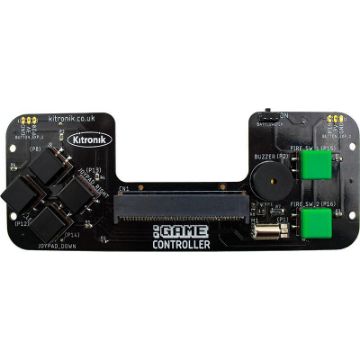
Kitronik :GAME Controller for the BBC micro:bit
KI 5644
The Kitronik :GAME Controller for the BBC micro:bit is a retro gaming accessory for the BBC microbit. It is a programmable gamepad-style controller enabling a better gaming experience on the micro:bit itself, or the ability to control other devices over micro:bit radio.
The :GAME Controller is similar in design and features to the the :GAME ZIP 64, only without the ZIP LED screen. This offers great value if the micro:bits own LED matrix is sufficient for the game or when it will be used to control other devices such as robots and buggies. It will also be much lighter on power consumption than its larger/older sibling.
It features on-board sound, 4 x directional buttons, 2 fire buttons, haptic feedback, and breakout points so shoulder buttons can be added. All of these features are fully programmable. The board is powered by two AA batteries, which also power the attached micro:bit.
The micro:bit connects to the board via the Edge Connector on the :GAME Controller. The micro:bit should be inserted firmly into the edge connector, ensuring that the micro:bit LED display is facing in the same direction as the front of the :GAME Controller.
Note: Care should be taken when using the external breakouts for pins 19 and 20 as GPIOs, as this can cause issues with the I2C devices on the micro:bit itself (e.g. compass and accelerometer). The BBC microbit is NOT included.
Features:A hand-held gaming solution for the BBC micro:bit.
Fully programmable on-board sound, directional buttons, fire buttons, and haptic feedback.
Breakout pads for adding shoulder buttons.
Ergonomic design for comfortable game-play.
It can also be coded to be a controller for your buggy or robotics projects.
We have created custom code blocks for the MakeCode Editor that are available as an Extension to the editor.
The board features an on/off switch to power the board on/off or to act as a reset if the :GAME Controller is in an enclosure where the micro:bits own reset switch cannot be accessed.
Contents:1 x :GAME Controller for the BBC microbit.
Dimensions:Length: 155mm.
Width: 60mm.
Center Width: 30.5mm.
Requires:2 x AA Batteries.
BBC micro:bit.
Type-A to Micro-B USB Cable.
MakeCode Editor.
The :GAME Controller is similar in design and features to the the :GAME ZIP 64, only without the ZIP LED screen. This offers great value if the micro:bits own LED matrix is sufficient for the game or when it will be used to control other devices such as robots and buggies. It will also be much lighter on power consumption than its larger/older sibling.
It features on-board sound, 4 x directional buttons, 2 fire buttons, haptic feedback, and breakout points so shoulder buttons can be added. All of these features are fully programmable. The board is powered by two AA batteries, which also power the attached micro:bit.
The micro:bit connects to the board via the Edge Connector on the :GAME Controller. The micro:bit should be inserted firmly into the edge connector, ensuring that the micro:bit LED display is facing in the same direction as the front of the :GAME Controller.
Note: Care should be taken when using the external breakouts for pins 19 and 20 as GPIOs, as this can cause issues with the I2C devices on the micro:bit itself (e.g. compass and accelerometer). The BBC microbit is NOT included.
Features:
Contents:
Dimensions:
Requires:
€21.95

Kitronik :VIEW Graphics 128 OLED Display for the BBC micro:bit
KI 56115
Display meaningful output from your micro:bit project with the Kitronik :VIEW Graphics128 OLED display. The Kitronik :VIEW Graphics128 OLED display gives the user the ability to add a monochrome 128x64 display to the BBC micro: bit. The onboard edge connector allows the micro:bit to slot into the board without any additional fixings. The board also features a micro:bit style I/O connector which means it can be slotted into any other micro:bit accessory that has a slot for inserting a micro:bit. All of the pins from the BBC micro:bit are tracked through to provide the edge pads with the full usage of the BBC micro:bit, with the addition of a display. As the micro:bit slots directly into the board, no tools, fixings, or soldering are required.
Power to the board can be provided via the edge connector or from the micro:bit. The board requires a 3V supply and has no voltage protection on the board. The board features an LED to indicate when the board has power. With every display, pixel turned on the board has a maximum power draw of 40mA. The 128x64 display uses the SSD1306 driver on an I2C interface. At the centre of the board are the breakout pads for the I2C lines, along with two ground pads and a 3V power pad. These pads are on a 2.54mm pitch, which means they will fit either wire or a pin header for jumper cables (not provided). This can be used by those who wish to add more I2C devices and functionality. It is possible to change the default I2C address of the board (see the Selecting Display section of this Datasheet for more details).
Features:Add a monochrome 128x64 OLED display to the micro:bit.
The micro:bit slots into the onboard edge connector.
The board features a micro:bit style I/O connector allowing it to be slotted into other micro:bit accessories.
It can be coded with MakeCode blocks and with Python.
Kitronik has created custom MakeCode blocks.
Kitronik has created a GitHub repo for custom Python functions.
It can be powered via the edge connector or by the micro:bit.
Requires a 3V supply.
The board features a power indicator LED.
It is possible to change the default I2C address of the board.
No tools, fixings, or soldering are required.
Dimensions:Length: 58mm.
Width: 52mm.
Height: 11.8mm.
PCB Thickness: 1.6mm.
Power to the board can be provided via the edge connector or from the micro:bit. The board requires a 3V supply and has no voltage protection on the board. The board features an LED to indicate when the board has power. With every display, pixel turned on the board has a maximum power draw of 40mA. The 128x64 display uses the SSD1306 driver on an I2C interface. At the centre of the board are the breakout pads for the I2C lines, along with two ground pads and a 3V power pad. These pads are on a 2.54mm pitch, which means they will fit either wire or a pin header for jumper cables (not provided). This can be used by those who wish to add more I2C devices and functionality. It is possible to change the default I2C address of the board (see the Selecting Display section of this Datasheet for more details).
Features:
Dimensions:
€19.95

Kitronik 3V Vertical Submersible Water Pump
KI 25110
This 3V vertical submersible low power water pump is an ideal solution for creating a small indoor water feature or as part of a plant watering system. At the heart of the pump is a 3V DC motor that runs quietly and only draws approximately 100mA.
The pump needs priming before use and should be kept fully submerged during use as it will only pump water not air. Also, it only works in one direction as a pump, you cannot reverse the connections and have it move water in the other direction.
It's 3V, 100mA power requirements are such that you could use a microcontroller with suitable drive capacity to switch it on or off. As the new micro:bit now has 200mA available for powering external devices, this pump can be powered directly by the micro:bit V2.
The micro:bit can only drive 15mA from its pins, so a transistor or FET is required to control it from the pins, either in an on/off capacity, or, with PWM to vary pumping rate. If using the original micro:bit or if the microbit is already controlling other devices, this pump can also be powered and controlled via a motor driver board, or similar.
Note: This pump is not supplied with any tubing.
Features:Vertical type submersible pump.
Operating power requirements are; 3V and 100mA.
Low noise DC motor.
Can be controlled with a simple on/off switch or microcontroller/motor driver board.
Ideal for small water features or plant watering systems.
A flow rate of 80L/H @ 3V and 100L/H at 4.5V.
Contents:1 x 3V Vertical Submersible Water Pump.
Dimensions:Length: 38.5mm.
Width: 23.9mm.
Height: 42.6mm.
The pump needs priming before use and should be kept fully submerged during use as it will only pump water not air. Also, it only works in one direction as a pump, you cannot reverse the connections and have it move water in the other direction.
It's 3V, 100mA power requirements are such that you could use a microcontroller with suitable drive capacity to switch it on or off. As the new micro:bit now has 200mA available for powering external devices, this pump can be powered directly by the micro:bit V2.
The micro:bit can only drive 15mA from its pins, so a transistor or FET is required to control it from the pins, either in an on/off capacity, or, with PWM to vary pumping rate. If using the original micro:bit or if the microbit is already controlling other devices, this pump can also be powered and controlled via a motor driver board, or similar.
Note: This pump is not supplied with any tubing.
Features:
Contents:
Dimensions:
€3.51
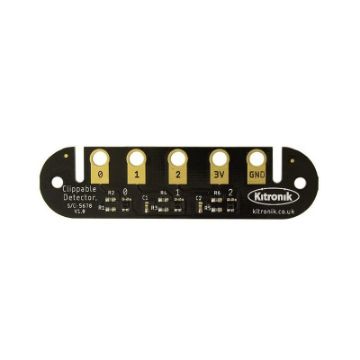
Kitronik Clippable Detector Board
KI 5678
The Clippable Detector board for the BBC micro:bit detects light, objects and can follow lines. The board is compatible directly with the BBC micro:bit and certain Kitronik boards, such as the Klip Motor Board.
The board works by using phototransistors to detect the reflectiveness of different surfaces. The Clippable Detector board has 3 phototransistor sensors evenly spaced out from each other. The sensors provide an analogue voltage to the BBC microbit. Five connections are required for full operation. These connections match those on a BBC micro:bit and can be attached using either bolts or croc-clip leads.
Kitronik have produced a set of custom MakeCode blocks for the Clippable Detector board. To add them to the editor, select the cog icon in the top right of the editor. Then, select Extensions from the drop down menu and in the search bar type and enter Kitronik. Pick the tile from the list and the new blocks will be added to the menu in the editor. It is also possible to use MicroPython to write code for this board.
Features:Use the board to detect light, objects or to follow lines.
The board is fitted with 3 phototransistors that detect the reflectiveness of different surfaces.
Connect the board directly to the micro:bit or connect using croc-clip leads.
Kitronik created custom MakeCode blocks to make the job of coding as easy as possible.
Contents:1 x Clippable Detector board for the BBC micro:bit.
Dimensions:Length: 77mm.
Width: 20mm.
Height: 2.8mm.
Mounting Hole Diameter: 3mm.
The board works by using phototransistors to detect the reflectiveness of different surfaces. The Clippable Detector board has 3 phototransistor sensors evenly spaced out from each other. The sensors provide an analogue voltage to the BBC microbit. Five connections are required for full operation. These connections match those on a BBC micro:bit and can be attached using either bolts or croc-clip leads.
Kitronik have produced a set of custom MakeCode blocks for the Clippable Detector board. To add them to the editor, select the cog icon in the top right of the editor. Then, select Extensions from the drop down menu and in the search bar type and enter Kitronik. Pick the tile from the list and the new blocks will be added to the menu in the editor. It is also possible to use MicroPython to write code for this board.
Features:
Contents:
Dimensions:
€6.95

Kitronik GAME Zip 64 for the BBC micro:bit
KI 5626
The Kitronik :GAME ZIP 64 is the ultimate retro gaming accessory for the BBC microbit. It has been designed to be an all in one hand held gaming platform, which also includes a built in, 64 (8x8) individually addressable full colour ZIP LED, screen.
It features on-board sound, 4 x directional buttons, 2 fire buttons, haptic feedback, and breakout points so shoulder buttons or I2C devices can be added. All of these features are fully programmable. We have also included breakout points to allow for the use of larger LED screens.
All of microbits features are still available when plugged in to the :GAME ZIP 64, so your games can still make use of the LED matrix, accelerometer etc.
Power is provided via the built in 3 x AA battery cages which have been ergonomically placed to act as hand grips which makes the :GAME ZIP 64 comfortable to hold and play.
Kitronik have produced some example games in both MakeCode Blocks and MicroPython that can be freely downloaded from the resources section below so you can begin playing games straight away. If you prefer to code your own games, it also offers the perfect platform for developing and testing micro:bit games.
Features:All in one hand-held gaming solution for the BBC micro:bit.
64 individually addressable ZIP LED display screen.
Fully programmable on-board sound, directional buttons, fire buttons, and haptic feedback.
Breakout pads for adding shoulder buttons or I2C devices.
Breakout pads for driving larger LED screens.
Ergonomic design for comfortable game-play.
Use MI:pro protector cases to create a handy game cartridge.
It can also be coded to be a controller for your buggy or robotics projects.
Contents:1 x :GAME ZIP 64 for the BBC microbit.
It features on-board sound, 4 x directional buttons, 2 fire buttons, haptic feedback, and breakout points so shoulder buttons or I2C devices can be added. All of these features are fully programmable. We have also included breakout points to allow for the use of larger LED screens.
All of microbits features are still available when plugged in to the :GAME ZIP 64, so your games can still make use of the LED matrix, accelerometer etc.
Power is provided via the built in 3 x AA battery cages which have been ergonomically placed to act as hand grips which makes the :GAME ZIP 64 comfortable to hold and play.
Kitronik have produced some example games in both MakeCode Blocks and MicroPython that can be freely downloaded from the resources section below so you can begin playing games straight away. If you prefer to code your own games, it also offers the perfect platform for developing and testing micro:bit games.
Features:
Contents:
€48.75
€39.00

Kitronik KLEF Piano for the BBC micro:bit
KI 5631
Compose a monophonic microbit musical masterpiece with the Kitronik :KLEF Piano for the BBC micro:bit. It features 15 capacitive touch pads, with 13 arranged as a single octave and 2 up down function buttons that can allow you to shift octaves.
:KLEF also features; an onboard amplifier circuit for extra 'more', an onboard speaker, and an onboard edge connector that the micro:bit slots into.
To use the Piano, the BBC micro:bit should be inserted firmly into the edge connector, either way around. If the Link Header is being used, the BBC micro:bit LED display should be facing the Piano keys. Kitronik has produced a MakeCode getting started guide which you can follow here.
Power is provided via a 5V micro USB connector. The board then produces a regulated 3.3V supply fed into the 3V and GND connections to power the connected BBC micro:bit, removing the need to power the BBC micro:bit separately. This also powers the capacitive touch sensor IC and audio amplifier.
The potential uses for the :KLEF Piano for the BBC micro:bit doesn't have to be just musical in nature. You can use the piano keys to transmit from the micro:bit attached to the board to other micro:bits over radio. And if that other microbit happened to be inserted into a :MOVE mini... Piano remote control! You can even take control of the :MOVE minis ZIP LEDs!
Features:Compose music using the micro:bit!
Learn to code and explore music at the same time.
Write code using the MakeCode, MicroPython, and Mu editors.
Use it as a control surface to trigger the sending of data via the microbits radio module.
Use it as a remote control for your Buggies/Robots.
It works with micro:bit V1 and micro:bit V2.
Dimensions:Length: 100mm.
Width: 110mm.
PCB Thickness: 1.6mm.
Max Height (No micro:bit): 17.3mm.
Max Height (With micro:bit): 53.3mm.
:KLEF also features; an onboard amplifier circuit for extra 'more', an onboard speaker, and an onboard edge connector that the micro:bit slots into.
To use the Piano, the BBC micro:bit should be inserted firmly into the edge connector, either way around. If the Link Header is being used, the BBC micro:bit LED display should be facing the Piano keys. Kitronik has produced a MakeCode getting started guide which you can follow here.
Power is provided via a 5V micro USB connector. The board then produces a regulated 3.3V supply fed into the 3V and GND connections to power the connected BBC micro:bit, removing the need to power the BBC micro:bit separately. This also powers the capacitive touch sensor IC and audio amplifier.
The potential uses for the :KLEF Piano for the BBC micro:bit doesn't have to be just musical in nature. You can use the piano keys to transmit from the micro:bit attached to the board to other micro:bits over radio. And if that other microbit happened to be inserted into a :MOVE mini... Piano remote control! You can even take control of the :MOVE minis ZIP LEDs!
Features:
Dimensions:
€23.95

Kitronik LAMP:bit Street Light for the BBC micro:bit
KI 5643
The LAMP:bit features connections which allow the microbit to be bolted/clipped directly to it. It has been designed to replicate a streetlight, in form and function. This is a great board for use in transportation projects and has been designed to fit the same aesthetic as the STOP:bit, so that they can be used together in the same projects.
The board also features a phototransistor that can be used to react to changes in ambient light levels, thus switching on and off the white LED autonomously.
Power is supplied to the board from the micro:bit that is connected to it via the 0V and 3V pins.
Features:The LAMP:bit is an accessory for the BBC micro:bit that replicates a street light.
It features a built-in phototransistor for autonomous switching.
The micro:bit can bolt-on/clip on to the board.
Follows the same aesthetic as the STOP:bit.
It can be used with the STOP:bit for larger projects.
Kitronik have created custom code blocks for the MakeCode Editor that are available as an Extension to the editor.
The bottom of the LAMP:bit PCB snaps off to form a stable cross base.
Contains:1 x LAMP:bit for the BBC micro:bit
5 x M3 8mm Countersunk Screws.
5 x M3 Hex Full Nut
Dimensions:Height: 135mm.
Width: 75mm.
Base Width: 42mm.
The board also features a phototransistor that can be used to react to changes in ambient light levels, thus switching on and off the white LED autonomously.
Power is supplied to the board from the micro:bit that is connected to it via the 0V and 3V pins.
Features:
Contains:
Dimensions:
€9.50

Kitronik LED Starter Kit
KI 2327
The LED kit contains red, green & yellow LEDs in 3mm, 5mm and 10mm round sizes as well as some Colour Changing and Tri colour LEDs plus some 5mm LED panel mounting holders. 105 parts are supplied in a multiple compartment storage box.
Features:Large selection of LEDs.
3mm, 5mm and 10mm Red LEDs.
3mm, 5mm and 10mm Green LEDs.
3mm, 5mm and 10mm Yellow LEDs.
5mm LED holders.
Colour Changing LEDs.
Tri colour 5mm diffused LEDs.
Contents:10 x 3mm Red LEDs.
10 x 5mm Red LEDs.
5 x 10mm Red LEDs.
10 x 3mm Green LEDs.
10 x 5mm Green LEDs.
5 x 10mm Green LEDs.
10 x 3mm Yellow LEDs.
10 x 5mm Yellow LEDs.
5 x 10mm Yellow LEDs.
10 x 5mm Panel Mount LED Clips.
10 x Colour Changing 5mm LEDs.
10 x Tri Colour 5mm LEDs.
1 x LED Kit box.
Kit Box Dimensions:Length: 174mm.
Width: 140mm.
Height: 32mm.
Compatible with:Raspberry Pi Pico
Micro:Bit
Features:
Contents:
Kit Box Dimensions:
Compatible with:
€28.95

Kitronik Miniature DPDT Slide Switch 10 Pack
KI 3404
A Miniature DPDT Slide Switch with solder terminals.
Max voltage = 50V DC.
Max current = 0.5A.
Body L 15, W 7, H 18mm.
Pack of 10
€4.26

Payment options


